北里大学大学院
スポーツ・運動器理学療法学
& スポーツ医学 研究室
共同著者・演者
Koji Saito , Masashi Kawabata , Hiroyuki Watanabe , Sohei Shimizu , Yudai Nagano , Hiroyoshi Masuma , Ryota Kuratsubo , Tomonori Kenmoku , Naonobu Takahira
概要
Abstract
Background: Medial elbow joint instability is a critical concern among young baseball players and is associated with throwing-related injuries. Greater medial elbow joint space (MEJS) gapping has been proposed as a key indicator of valgus instability. However, age-specific differences remain unclear, particularly in elementary school-age pitchers.
Hypothesis/purpose: This study aimed to clarify age-related differences in MEJS gapping by comparing joint space changes between resting and gravity stress conditions among young baseball players. It was hypothesized that 12-year-old players would show greater changes in MEJS compared with younger players.
Study design: Cross-sectional study; Level of evidence, 3.
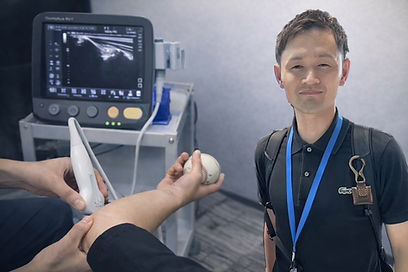
Methods: This study included 190 young baseball players (mean age, 11 ± 0.6 years) from 22 teams. Ultrasonographic assessment of the MEJS was performed during a resting and a gravity-induced valgus stress test. The change in MEJS was defined as the distance between the medial humeral epicondyle and the sublime tubercle of the ulna measured under each condition. The Kruskal-Wallis test was used to compare changes in MEJS among 3 age groups (10, 11, and 12 years), and the Wilcoxon rank-sum test was used to assess differences between the throwing and nonthrowing sides. Multiple regression analysis was performed to identify factors associated with the change in MEJS on the throwing side.
Results: Significant age-related differences in MEJS changes were observed (P = .03). Post hoc analysis revealed that 10-year-old players (median, 0.75 mm [interquartile range [IQR], 0.34-1.27]) exhibited significantly greater changes in MEJS on the throwing side compared with 12-year-old players (median, 0.47 mm [IQR, 0.25-0.70]; P = .03). The change in MEJS on the throwing side was significantly greater than that on the nonthrowing side across all age groups (P < .01). Change in MEJS on the nonthrowing side (β = 0.56; P < .01) and age (β = -0.14; P = .03) were associated with the change in MEJS on the throwing side (R 2 = 0.38; P < .01).
Conclusion: Our study demonstrated that 10-year-old players showed greater MEJS changes than 12-year-old players, highlighting the need for age-specific interpretation. These changes may reflect physiological joint laxity related to growth rather than pathological instability, with implications for ultrasonographic interpretation and injury risk.
Keywords: instability; joint laxity; medial elbow joint space; ultrasonography; valgus stress; youth.
Sage Journals:https://journals.sagepub.com/doi/full/10.1177/23259671261420424 PubMed:https://pubmed.ncbi.nlm.nih.gov/41783391/ https://pmc.ncbi.nlm.nih.gov/articles/PMC12953976/